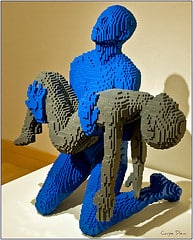
Scultpure – “My Boy” by Nathan Sawaya – photo by Tony the Misfit @ Flickr Away from this blog, I run the Samuel Morris Foundation. The Foundation supports children disabled by non-fatal drowning or other hypoxic brain injuries and prevents future drowning death and disabilities through education and awareness.
Through the work at the Samuel Morris Foundation, I have the privilege of meeting some really amazing children and their parents. Children and parents whose lives have been forever altered.
Joshua’s story
One child I had the privilege of meeting and the foundation was able to provide some assistance to was Joshua. Joshua experienced a non-fatal drowning in his families backyard swimming pool in February 2009.
Joshua fought hard to battle on, unfortunately, Josh was left with severe disabilities and a constant battle to continue to breathe. Josh’s parents fought an amazing battle to give Josh the best possible chance at surviving and having the best possible life that his medical condition would allow.
Eighteen months to the day Josh lost his battle and passed away quietly at home on Friday last week.
Following Josh’s death, I was attending the 6th Annual AUSTSWIM National Aquatic Education Conference. A gathering of aquatics industry people from around Australia and New Zealand. Josh’s parent demonstrated their own courage in many ways. One of which was giving the Samuel Morris Foundation permission to discuss Josh’s story at the Conference.
Josh’s courageous battle touched the hearts of everyone who heard his story.
Behind the scenes – family grief
I have been reflecting on Josh’s courage to fight on for eighteen months, and the courage of other children (including my own) to continue to battle against the odds, and the impact that this has on families.
Many people never see or understand the constant battle that happens for non-fatal drowning survivors and their families. They have to deal with an ongoing process of grief and the prospect of losing their child again. While reflecting on how this is I found an excellent article by Deborah Tiel Millard on a grieving process.
Deborah wrote the article for E-Zine “Complex Child”. While Deborah’s child did not have a non-fatal drowning, Deborah and her family battled for eight years with the complex needs of a chronically ill child and she explains the grieving process better than I could. So for an insight into the lives of families living with children with complex medical needs please read: A Process of Grief: The Reality of Grieving a Child with Complex Health Care Needs.
The sad statistics on child drowning
Drowning is one of the leading causes of death for children aged 0-4 in most developed countries like Australia, New Zealand the USA etc. For every child that dies as a result of drowning many more are admitted to hospital following a non-fatal drowning and around one-quarter of these children will sustain a brain injury that leaves them with disabilities for life.
The situation is even worse in developing countries where many thousands of children lose their lives due to drowning every year.
Help us stop these tragedies
The best way to avoid these tragedies is through education and awareness. You can help us in these efforts by joining the Samuel Morris Foundation email list. The Foundation newsletter includes updates on what is happening in drowning prevention and provides links to practical tools and sites that you can share with your friends and family to help keep our children safe.
The Samuel Morris Foundation is also committed to ensuring that children disabled by non-fatal drowning have the best possible quality of life. The equipment that these children require is expensive, but essential to their quality of life. You can help out by making a donation